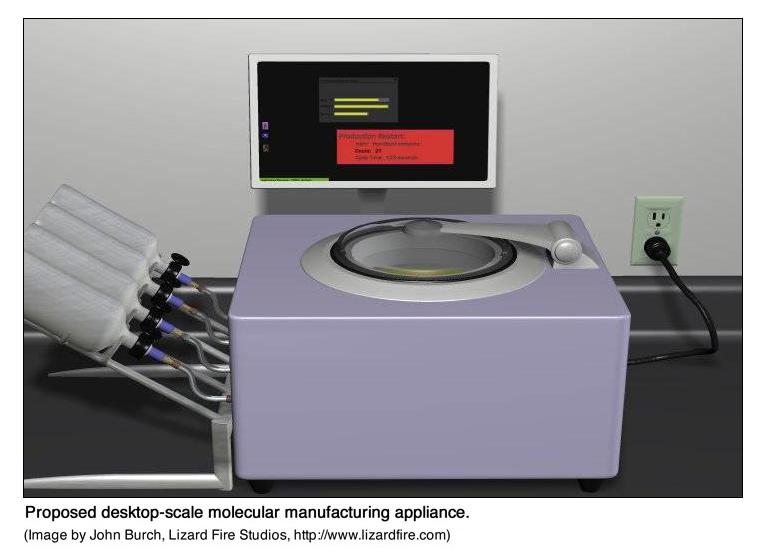
To the outsider, the debate about whether Drexler’s vision of radical nanotechnology – molecular manufacturing or molecular nanotechnology (MNT) – is feasible or not can look a bit sterile. Many in the anti- camp take the view that the Drexler proposals are so obviously flawed that it’s not really worth spending any time making serious arguments against them, while on the pro- side the reply to any criticism is often “it’s all been worked out in Nanosystems, in which no errors have been found”. I think the recent debate we had at Nottingham did begin to move onto real issues. I can’t help feeling, though, that the time has come to move on from debating positions.
With this in mind, here are six areas in which I think the proposals of molecular nanotechnology are vulnerable. Trying to be constructive, I’ve tried, as far as possible, to formulate the issues as concrete research questions that could begin to be addressed now. Ideally, we would be seeing experimental work – this field has been dominated by simulation for too long. But theory and simulation does have its place; one has to recognise the limitations of the simulation methods being used and to validate the simulations against reality whenever possible. A couple of recent developments from the pro-MNT camp are encouraging – the Drexler/Allis paper (PDF) used state of the art quantum chemistry methods to design a “tool-tip” for mechanosynthesis, while the Nanorex program should make it much more convenient to do large scale molecular dynamics simulations of complex machine systems. What’s needed now is a systematic and scientific use of these and other methods, moderated by frequent reality checks, to answer some well-posed questions. Here are my suggestions for some of those questions.
1. Stability of nanoclusters and surface reconstruction.
The Problem. The “machine parts” of molecular nanotechnology – the cogs and gears so familiar from MNT illustrations – are essentially molecular clusters with odd and special shapes. They have been designed using molecular modelling software, which works on the principle that if valencies are satisfied and bonds aren’t distorted too much from their normal values then the structures formed will be chemically stable. But this is an assumption – and two features of MNT machine parts make this assumption questionable. These structures typically are envisaged as having substantially strained bonds. And, almost by definition, they have a lot of surface. We know from extensive experimental work in surface science that the stable structure of clean surfaces is very rarely what you would predict on the basis of simple molecular modelling – they “reconstruct”. One highly relevant finding is that the stable form of some small diamond clusters actually have surfaces coated with graphite-like carbon (see here, for example). There are two linked questions here. We need to know what is the stable structure at equilibrium – that is the structure with the overall lowest free energy. It may be possible to make structures that are metastable – that is, structures that are not at equilibrium, but which have a low enough probability of transforming to the stable state that they are usable for practical purposes. To assess whether these structures will be useful or not, we need to be able to estimate two things – the energy barrier that has to be surmounted, and how much energy is available in the system to push it over that barrier. The second of these factors is going to be closely related to challenge 3.
Research needed. Firstly, we need proper calculations, using quantum chemistry techniques (e.g. density functional theory) of the chemical stability of some target machine parts. Subsequently it would be worth doing molecular dynamics calculations with potentials that allow chemical reactions to probe the kinetic stability of metastable structures.
2. Thermal noise, Brownian motion and tolerance.
The Problem. The mechanical engineering paradigm that underlies MNT depends on close dimensional tolerances. But at the nanoscale, at room temperature, Brownian motion and thermal noise mean that parts are constantly flexing and fluctuating in size, making the effective “thermal tolerance” much worse than the mechanical tolerances that we rely on in macroscopic engineering. Clearly one answer is to use very stiff materials like diamond, but even diamond may not be stiff enough. The Nanorex simulations show this “wobbliness” very clearly. It should be remembered that in these simulations, the software nails down the structures at fixed points, but in reality the supports and mountings for the moving parts will all be just as wobbly. Will it be possible to engineer complex mechanisms in the face of this lack of dimensional tolerance?
Research needed. Drexler’s “Nanosystems” correctly lays out the framework for calculating the effects of thermal noise, but the only application to an engineering design of these calculations is a calculation of positional uncertainty at the tip of a molecular positioner. This shows that the positional uncertainty can be made to be less than an atomic diameter – this is clearly a necessary condition for such devices to work, but its not obvious that it is a sufficient one. What is needed to clarify this issue are molecular dynamics simulations carried out at finite temperatures of machines of some degree of complexity, in which both the mechanism itself and its mounting are subject to thermal noise.
3. Friction and energy dissipation.
The Problem. As mechanisms get smaller, the relative amount of interfacial area becomes much larger and surface forces become stronger. As people attempt to shrink micro-electromechanical systems (MEMS) towards the nanoscale the combination of friction and irreversible sticking (called in the field “stiction” ) causes many devices to fail. It’s an article of faith of MNT supporters that these problems won’t be met in MNT systems, because of the atomic perfection of the surfaces and the rigorous exclusion of foreign molecular species from the inner workings of MNT devices (the “eutactic environment” – but see challenge 5 below). Its certainly true that the friction of clean diamond surfaces is likely to be very low by macroscopic standards (the special frictional properties of diamond were already understood by David Tabor), particularly if the two sliding surfaces aren’t crystallographically related. However, in cases where direct comparisons can be made between the estimates of sliding friction in Nanosystems and the results of molecular dynamics simulations (e.g. Harrison et al., Physical Review B46 p 9700 (1992)) the Nanosystems estimates turn out to be much too low. MNT systems will have very large internal areas, and as they are envisaged as operating at very high power densities; thus even rather low values of friction may in practise compromise the operations of the devices by generating high levels of local heating which in turn will make any chemical stability issues (see challenge 1) much more serious.
Given that the machine parts of MNT are envisaged as being so small, and the contacting area of these parts is so large with respect to their volumes, it’s perhaps questionable how useful friction is as a concept at all. What we are talking about is the leakage of energy from the driving modes of the machines into the random, higher frequency vibrational modes that constitute heat. This mode coupling will always occur whenever the chemical bonds are stretched beyond the range over which they are well approximated by a harmonic potential (i.e. they obey Hooke’s law). At least one of the Nanorex simulations shows this leakage of energy into vibrational modes rather clearly.
Research needed. The field of nanoscale friction has moved forward greatly in the last ten years (a good accessible review by Jacqueline Krim can be found here), and an immediate priority should be to explore the implications to MNT of this new body of existing experimental and simulation work. Further insight into the scale of the problem and any design constraints it would lead to can then be obtained by quantitative molecular dynamic simulations of simple, driven nano-mechanical systems.
4. Design for a motor.
The Problem It’s obvious, on the one hand, that MNT needs some kind of power source to work. On the other hand, MNT supporters often point to the very high power densities that it will be possible to achieve in MNT systems. The basis of their confidence is a design for an electrostatic motor in Drexler’s “Nanosystems”, together with some estimates of its performance. The design is very ingenious in concept – it essentially works on the principle of a Van der Graaf generator worked backwards. The problem is that only the broad outline of the design is given in Nanosystems, and when one thinks through in detail how it might be built more and more difficulties emerge. The design relies on the induction of charge by making successive electrical contact between materials of different work-functions. The materials to be used need to be specified and the chemical stability of the resulting structures need to be tested as in challenge 1. This is a potentially tricky problem, as the use of any kind of metal is likely to raise serious surface stability issues. The design also specifies that electrical contact is made by electron tunneling rather than direct physical contact. This is probably essential in order to avoid immediate failure due to the adhesion of contacting surfaces (this would certainly happen with a metallic contact), but in turn, because of the exponential dependence of tunnelling current with separation) it calls for exquisite precision in positioning, which brings us back to the problems of tolerance in the face of thermal noise discussed in challenge 2.
Research needed. The electrostatic motor design needs to be worked up to atomistic level of detail and tested.
5. The eutactic environment and the feed-through problem.
The Problem It is envisaged that the operations of MNT will take place in a completely controlled environment sealed from the outside world – the so-called “eutatic” environment. There are good reasons for this: the presence of uncontrolled, foreign chemical species will almost certainly lead to molecular adsorption on any exposed surfaces followed by uncontrolled mechanochemistry leading to irreversible chemical damage to the mechanisms. MNT will need an extreme ultra-high vacuum to work. (It’s worth noting, though, that even in the absence of the random collisions of gas molecules Brownian motion – in the sense of thermal noise – is still present at finite temperatures). But, to be useful, MNT devices will need to interact with the outside world. A medical MNT device will need to exist in bodily fluids – amongst the most heterogenous media its possible to imagine – and a MNT manufacturing device will need to take in raw materials from the environment and deliver the product. In pretty much any application of MNT molecules will need to be exchanged with the surroundings. As anyone who’s tried to do an experiment in a vacuum system knows, it’s the interfaces between the vacuum system and the outside world – the feed-throughs – that cause all the problems. Nanosystems includes a design for a “molecular mill” to admit selected molecules into the eutactic environment, but again it is at the level of a rough sketch. The main argument about the feasibility of such selective pumps and valves is the existence of membrane pumps in biology. But I would argue that these devices are typical examples of “soft machines” that only work because they are flexible. Moreover, though a calcium pump is fairly effective at discriminating between calcium ions and sodium ions, its operation is statistical – its selectivity doesn’t need to be anything like 100%. To maintain a eutactic environment common small molecules like water and oxygen will need to be excluded with very high efficiency.
Research needed. Molecular level design of (for example) a selective valve or pump based on rigid materials that admits a chosen molecule while excluding (say) oxygen and water with 100% efficiency.
6. Implementation path.
The Problem The all-important practical question is, of course, how do we get from our technological capabilities today to the capabilities needed to implement MNT. Here there is a difference of opinion within the pro-MNT camp, with two quite different approaches being proposed. Robert Freitas believes that the best approach is to develop the current approaches of direct molecular manipulation using scanning probe microscopes to the point at which one is able to achieve a true mechanosynthetic step. This is interesting science in its own right, but some idea of the formidable difficulties involved can be found by reading Philip Moriarty’s critique of a specific proposal by Robert Freitas, and the subsequent correspondence with Chris Phoenix. Drexler himself prefers the idea of developing a biomimetic soft nanotechnology very much along the lines of what I describe in Soft Machines, and then making a transition from such a soft, wet system to a diamond based “hard” nanotechnology. This involves a transition between two completely incompatible environments, and two incompatible design philosophies, and I simply don’t see how it could happen. Without a concrete proposal it’s difficult to judge feasibility or otherwise.
Research needed. Engage with scanning probe microscopists to overcome the formidable experimental problems in the way of direct mechanosynthesis. Develop a concrete proposal for how one might make the transition between a functional, biomimetic “soft nanotechnology” system and hard MNT.
 – let’s prevail.