There’s a long interview with me by Ollie Barrett on Cylch – Alumni Wales, a substack devoted to highlighting the contributions of Welsh professionals in England. This covers my scientific career, my thoughts on industrial policy and regional economic growth, my Welsh roots, and (inevitably) my take on Andy Burnham’s plans for growth in every postcode.
Category: Autobiography
The Year in Soft Machines
The Soft Machines blog has been going for more than twenty years, I’m astonished to say. It’s good to see a substantial increase in the number of readers in 2025’s later months – no doubt helped by the fact that, with a bit more time on my hands, I’ve been writing a bit more regularly. For the benefit of new readers and old, here’s a review of some of the year’s posts, set in the context of some of this blog’s recurring themes.
The UK’s productivity and economic growth problem
The UK’s continuing economic stagnation remains a continual preoccupation, unfortunately. A recent post presents the most recent data for GDP per capita, showing that the country is around 30% worse off than if the pre-2008 trend had continued. Such a dramatic change in economic fortunes must have a cause – or causes. Stating what should be obvious, but doesn’t seem to be, to many commentators, I insist that the causes must precede the big break in 2008, and that there may be long lags between cause and effect. But one can always make things worse with subsequent bad decisions.
The UK’s continuing economic growth crisis
Fundamentally, our economic problems are problems of productivity growth – or lack of it. I’ve been writing about this for about a decade, with a post from earlier in the year summarising some of the arguments:
Ten Years of Banging on about Productivity
Why does this matter? From the government’s perspective, projections of future productivity growth make a big difference to how much public spending can grow or how much taxes have to rise to keep the government within its fiscal rules. The role of the Office of Budgetary Responsibility in making forecasts is key here, but its record in predicting future productivity growth is frankly risible, as I discussed in the context of the Spring Statement:
Why productivity growth is important – Spring Statement 2025 Edition
Productivity and GDP per capita are technical concepts, so it might be thought that these issues aren’t relevant to people’s everyday lives. Nothing could be further from the truth – the slowdown in productivity is directly reflected in peoples’ earnings, shown dramatically in this plot from:
The End of Wage Growth in the UK

Average real weekly UK wages. Green: Composite Average Weekly Earnings series, corrected for inflation using consumer prices index. Thomas, R and Dimsdale, N (2017) “A Millennium of UK Data”, Bank of England OBRA dataset. Brown: ONS, Real Average Weekly Earnings, total pay, using CPI (seasonally adjusted). 18/2/2025 release.
Everything that’s wrong with politics and economics in the UK can be traced back to stagnating productivity.
Towards economic growth, energy and progress
Is this economic stagnation inevitable? I don’t think so – I believe it to be the result of policy choices the country has made, and different choices are possible. I welcome a growing movement of commentators and think-tanks exploring concrete policy ideas to break the stagnation, though I don’t always agree with their priorities. At the end of last year, I wrote what I hope comes across as a sympathetic critique of one strand of thought –
Taking Anglofuturism Seriously
One theme that is at the centre of much of this kind of writing prioritises cheap, abundant energy, with a new roll-out of nuclear power put centre-stage. I’m in sympathy with this, though I don’t think the analysis of the recent failure of the UK to build new nuclear power stations goes far enough. In 2014, the government planned to build 18 GW of new nuclear power; as I write, none has been delivered, and only 3.2 GW is under construction. Much emphasis is placed on the need to remove regulatory barriers; this in my view is necessary, but not sufficient: more thought needs to be given to how to rebuild national capabilities, as I argue here:
Ownership, Control, National capability: learning lessons from the UK’s nuclear new build debacle
Another recent feature of the UK economy is a rapid decline in the share of the economy accounted for by manufacturing – a decline shared by other developed economies, but which has been particularly large in the UK. Manufacturing now accounts for 8% of UK economy; should we try & increase this? I think so, but it’s important to distinguish some good arguments for this from bad ones (and recognise some uncertainties). Manufacturing matters for its potential for productivity growth – what’s important is the value it creates, not the jobs. Manufacturing capability is also important for national security, but realism is needed about UK’s position as <3% of world high tech economy – we need to aim for security, not autarky.
Good reasons and bad reasons for supporting manufacturing (and some uncertainties)
On artificial intelligence
Inevitably, I have written about artificial intelligence. I don’t think anyone knows how this story is going to play out, least of all me, so back in May I sketched out three scenarios for the economic impact of AI:
1. Intelligence explosion – the Silicon Valley vision of AI entering a state of recursive self-improvement, leading to artificial general intelligence, and a winner takes all economy, in which the controllers of the new technologies enjoy unprecedented political and economic power.
2. Excel in prose – in which AI is understood as a powerful normal technology, whose applications lead to significant productivity gains across a number of sectors, but with a delay as business processes have to be adapted to make the most of the new technology.
3. Crash and burn – in which the revenues generated by applications of AI are disappointing, and can’t justify the huge capital investments have been made in AI infrastructure. The subsequent bursting of a financial bubble leads to systemic damage to the world financial system and the real economy.
Writing in May, I described “Crash and burn” as a contrarian scenario, but in the last few months it seems to have become mainstream; one can’t open up the Financial Times app without coming across an AI Bubble article.
The economic impact of AI: three scenarios
One aspect of the AI story that I think has been neglected is the state of the material base that underlies the technology – the integrated circuits that are used to train and run the AI models. For many decades, we came to rely on an exponential increase in computer power, arising from the miniaturisation of the circuit components expressed in Moore’s Law.
Moore’s Law is still evoked by commentators as a symbol of accelerating technological change, but in fact the rate of increase in raw computer power has slowed substantially over the last two decades. Available computer power for applications such as large language models is still increasing, but this increased power is coming, less from miniaturisation, more from software, specialised architectures optimised for particular tasks, and advanced packaging of chips.
 Minimum transistor footprint (product of metal pitch and contacted gate pitch) for successive semiconductor process nodes. Data: (1994 – 2014 inclusive) – Stanford Nanoelectronics Lab, post 2017 and projections, successive editions of the IEEE International Roadmap for Devices and Systems
In the classical heyday of Moore’s Law, from the mid 1980’s to the mid 2000’s, computer power grew at a rate of 50% a year compounded, doubling every two years. In this extraordinary period, there was more than a thousandfold cumulative increase over a couple of decades.
Now, in contrast, it is not the supply of computer power that is increasing exponentially; we have an exponential increase in demand, while the increase in supply has more of a linear character.
In “AI and the manufacturing firm of the future”, I ask how AI will change ht world of manufacturing. Sam Altman, CEO of OpenAI, has written about a manufacturing singularity, with AGI powered humanoid robots building factories to make more robots. I ask, as politely as I can, whether this vision reflects his lack of understanding of the material base of our industrial world, is a somewhat overheated metaphor, or is just bullshit (in Harry Frankfurt’s sense – i.e. an utterance whose intended effect is uncoupled to any truth value).
An alternative scenario is of AI driving process & system optimisation in increasingly automated factories. If Altman’s vision is driving strategies in the USA, I think the latter scenario is the one being aggressively pursued in China. We’ll see which is closer to reality.
AI and the manufacturing firm of the future
UK science and university policy
Until my retirement at the end of September this year it was very much part of my day job to think about science and university policy in the UK. UK Universities have been under huge financial pressure in recent years, so some might be tempted to step back from their role in their communities. In this piece I argued that this would be a big mistake, and instead they should take even more seriously their role supporting regional economies.
The civic university in hard times
The next piece offers a much more personal view of the role of universities in their regions – it’s a retrospective on my time as Vice-President for Regional Innovation and Civic Engagement at the University of Manchester, reviewing the progress we have made working with partners in the city-region to realise the University’s potential to support Greater Manchester’s economy.
On leaving the University of Manchester
Finally, my most popular post of the year was this rather provocative piece: UK Science in a post-liberal world. Here, I argue that a multi-decade period of consensus in UK science policy is likely soon to come to an end, and that the UK’s research system must respond to a new focus on re-building, re-energising, re-arming and re-industrialising for a changed & hostile world.
UK Science in a post-liberal world
Family matters
To turn to personal matters, my mother, Sheila Jones, died on October 31st this year, a little more than two years after the death of my father, Robbie Jones. I found it helpful to write these two pieces to celebrate their lives, and to reflect on where I have come from.
Sheila Howell Jones (1934 – 2025) , Robert Cecil Jones (1932 – 2023)
On leaving the University of Manchester
This year marked the end of my full-time career as an academic – I retired from the University of Manchester at the end of September 2025. I was a lecturer at Cambridge University from 1989 to 1998, when I moved to the University of Sheffield. I was a professor of physics at Sheffield, and also, between 2009 and 2016, Pro-Vice-Chancellor for Research and Innovation. I moved to the University of Manchester in 2020, where latterly I have had the role of Vice-President for Regional Innovation and Civic Engagement. I was touched and honoured by the kind words spoken about me at an event to mark my retirement in September. UoM President Duncan Ivison, Manchester City Council Chief Executive Tom Stannard, and the Chair of UoM’s Board of Governors Phillipa Hurd all spoke, and GM Mayor Andy Burnham sent a video message. In response, I said something along these lines:
Thanks for all your kind words. I’m conscious that I’ve only been at Manchester for 5 years, in contrast to many of you who have devoted a much longer time to the institution.
My career has taken me from Cornell, through Cambridge, to Sheffield (with quite a lot of time in Swindon, first on secondment to run the cross-council nanotechnology programme, then as EPSRC Council Member), and, as Duncan said, it’s taken a number of twists and turns – I often describe myself as a deviant physicist. There’s been science – both blue skies and highly collaborative with industry, public engagement, science policy, and contributions to local economic development and attempts to influence national policy.
I think my time at Manchester has been a culmination of that career, where I’ve been able to bring together all those different strands in the service of a great university in a great city.
Continue reading “On leaving the University of Manchester”Sheila Howell Jones (1934-2025)
Sheila Jones, my mother, died on Friday 31 October 2025. Born and raised in West Wales, she spent much of adulthood in England, as a primary teacher in a variety of schools. She returned to Wales when her husband, Robbie Jones, became a priest in the Anglican Church in Wales, finally moving to Derbyshire to be close to her son’s family.
Sheila Jones, née Lewis, was born in the Pembrokeshire village of Letterston. Her father, John Lewis, was one of thirteen children of Arnold and Alice Lewis. Arnold Lewis was an agricultural merchant – and, by all accounts, something of a domestic tyrant. He assigned careers to all his sons; John was to be a priest, and was sent to train in St David’s College, Lampeter. Rebelling against this, John dropped out of theological college to become a Conservative Party activist.
Continue reading “Sheila Howell Jones (1934-2025)”All things begin & end on Albion’s Rocky Druid shore
I’m 63 now, so the idea that I should still be taking part in “adventure sports” is perhaps a little ridiculous. Nonetheless, rock climbing has been so much part of my life for so long that I still try and get out, generally for easy short climbs on the gritstone cliffs near my home in Derbyshire. There are things that I’ve done in my younger days that I have put behind me without much regret – I won’t be climbing frozen waterfalls in New England again, or winter climbing in the Lakes or Scotland. I do miss snowy mountains a bit, though I know I will never be a serious alpinist. But there’s one variety of cllmbing that I think is very special, that I look back on with real pleasure, and that I think maybe I should try to involve myself in once again, even if at a much lower level than before. That is rock climbing on Britain’s sea-cliffs, a branch of the pastime with its own unique atmosphere and set of demands.
I started rock climbing seriously when I was 14 or so; at that time it was my family’s habit to spend every summer in St Davids, Pembrokeshire, near where my mother had grown up. The coastline of Pembrokeshire is spectacular – a succession of coves, headlands, and cliffs, pounded by the open Atlantic waves. At the time, the idea of climbing the cliffs of Pembrokeshire was in its infancy. Rock climbing on the granite cliffs of Cornwall was well-established, and the counter-cultural climbing scene of North Wales had created hard and serious routes on the sea-cliffs of Gogarth, on Anglesea. But what little climbing on the cliffs of Pembrokeshire was recorded in a slim guidebook by Colin Mortlock, published in 1974, not by the Climbers Club or any of the establishment sources of climbing information, but by a local publishing house more associated with postcards and wildlife guides than rock climbing.

The first ever guidebook to climbing in Pembrokeshire, by Colin Mortlock. Just 150 pages long (the current guidebook runs to 5 volumes), it often failed in the basic function of telling one where the routes go (and, in one or two cases, even where the cliffs actually are), but was a source of great inspiration. The cover photograph is of Colin Mortlock himself climbing “Red Wall” at Porthclais.
My imagination was seized by the cover of this book, showing Mortlock himself powering up a sheer, apparently overhanging, wall above a boiling sea. The route was called “Red Wall”, and was graded “severe” – that was the kind of climbing I wanted to do. In 1977 I persuaded my school friend and climbing partner Mark Miller to come and stay with my family in Pembrokeshire so we could give this sea-cliff climbing business a try.
Mark and I were, by that time, reasonably confident climbers up to grades of severe, with some level of basic competence at rope work and protection, and in possession of the basic gear – ropes, harnesses, the nuts and slings that were state of the art at the time. We studied the guidebook and looked at the picture. It looked steep – but surely, if it were that overhanging, the holds must be good. We’d done routes like that on the gritstone cliffs of Derbyshire, we thought – tough routes for the grade, but within our grasp.
But we’d misjudged it. The cover picture turned out to wildly tilted; it’s an off-vertical slab, maybe 70 degrees or so, blessed with perfect sharp, incut finger holds. We romped up it. Severe? It would barely be V. Diff in the Peak District! But it remains one of my favourite routes – I’ve probably done it twenty times since then. Few routes capture so completely the joy of sea-cliff climbing at its friendliest, with easy access to the base of the route, clear blue water sloshing gently below one’s feet, lichen and rock samphire on beautiful pink rock, footholds and handholds in all the right places.
Mark and I got better and more experienced at climbing. By the time we left school I was a confident leader of climbs VS in grade, tentatively trying things that were a bit harder. Mark had by force of will converted himself into an extreme leader, with a specialism in bold, protection-less slabs. In the summer before I went to University, in 1980, we persuaded a relatively new friend, Peter Carter, to come with us to Cornwall and Devon. Or, more accurately, we persuaded Peter to take us there – recently discharged from the Royal Marines, he had the unique asset of owning, and knowing how to drive, a small van.
Our trip started at the very tip of Cornwall – on the granite cliffs of West Penwith. We did some fine climbs on the traditional cliffs of solid granite, like Bosigran and Chair Ladder. But it was on the return trip that our sea-cliff horizons were truly expanded. A bleak headland near the north coast village of St Agnes is known to climbers as Carn Gowla, with three hundred foot cliffs falling vertically into the deep sea.
The route we chose was a HVS called Mercury. The first problem is getting to the base of the route – the only way was to abseil. We tied two 150ft 9 mm ropes together, anchored them to a good thread in the slope above the groove, and set off down. At the bottom, a ledge about twenty feet above the waves, there’s a huge sense of commitment – the easiest way out is the route Mercury, all 270 ft of it. In the end, the technical difficulties weren’t beyond us, though the exposure, commitment, and the dubious, vegetated rock were very far from the friendly crags of the Peak District.
Another highlight of that trip was my first encounter with the spectacular scenery on the stretch of coast north from Bude to Hartland. Known as the Culm Coast, it’s composed of thinly bedded sandstones and shales that have been dramatically folded, and then sliced abruptly by the sea. Not only is it the most dramatic coastal scenery in England, it also provides a variety of great climbs, ranging from short and solid sea-washed slabs to 400 foot climbs, almost of mountain scale, on rock whose solidity is not above suspicion. I’ve returned to it again and again.
There’s something uniquely memorable, I think, about sea cliff climbs, and even decades on I vividly remember the climbs and the people I did with them with. On the Culm Coast there’s a 400 ft climb called Wrecker’s Slab. The first time I did it was with my college friend Jonathan Sharp, I think just a few months before he tragically died in the Alps. It wasn’t hard, but its scale and looseness gave it quite a reputation, well-deserved.
In Pembrokeshire, amongst the cliffs north of St Davids, Trwyn Llwyd is a fabulous buttress of solid gabbro. I did Barad with Sean Smith; its crux felt like a VS gritstone jamming crack – 200 feet directly above the sea. Craig Coetan is a much easier crag, above a little inlet which attracts curious seals. In my teenage years I explored these gentle slabs with my father.
Back in the Culm coast, the hardest route I did was with my old and much missed friend, the late Mark Miller. Blackchurch is a crag with a sinister atmosphere that entirely lives up to its name; Archtempter is one of the classics of the main cliff – a soaring groove line now graded E3. Mark did the first pitch, thin and loose, and I led the widening crack above through an overhang. At the top, we so far forgot ourselves to shake hands.
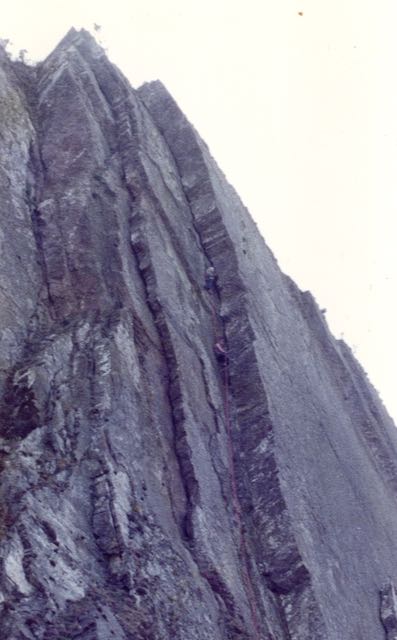
Blackchurch, North Devon. The obvious groove is the line of “Archtempter”; the (just visible) climbers are Mark Miller at the halfway stance, and above him the author, just about to enter the overhanging section. It’s not a great photo, but it does convey something of the demonic atmosphere of this crag.
Looking for new routes provides another, exploratory dimension to sea-cliff climbing; I had many memorable trips with Brian Davison, who believed that the purpose of guide books was to tell you where not to climb. In the Lleyn Peninsula, we did one of the earliest routes up Craig Dorys; we called it “Error of Judgement”. As the guidebook says: “It certainly was, an appallingly loose line”.
In North Pembrokeshire Penbwchdy is a long headland with a long run of big, vegetated cliffs. I’d been there with Jonathan Sharp but failed to get up anything – we’d scrambled down a grassy slope, done a 150 ft abseil to sea level to find our way forward was to cross a deep but narrow inlet on the remains of a wrecked ship. Not relishing the idea of balancing across on an old propeller shaft, over which waves were breaking, we went back the way we came.
The great pioneer of sea-cliff climbing, Pat Littlejohn, had a done a route at the far end of Penbwchdy, on a section of cliff he called New World Wall, accessed by a long low-tide sea level traverse after the shipwreck crossing that Jonathan and I had balked at. Done in 1974, I suspect Terranova, as the route was called, hadn’t had a lot of repeats, given the awkward approach. But Brian and I later found another way down to New World Wall, with some careful route finding and a final scramble. Brian led a new route up this, which he called “New Dawn Fades”, at E4, a good onsight lead up a steep groove.
The best new route I ever did was on the sandstone cliffs south of St Davids, a couple of miles east of Porthclais. A pamphlet describing new routes reported a new crag on the headland near Caerfai, with a HVS called “Amorican”, now a classic and often repeated route. I kicked myself – I’d walked past that crag innumerable times but never noticed its potential. But to the right of the crack of Amorican is a sweeping concave slab of sandstone, unclimbed in 1984. Climbing with Mary Rack, I found a circuitous line; a thin sloping crack demanded 20 ft of intricate and precise footwork, with only tiny holds for the hands. I called it “Uncertain Smile”.
Sea cliff climbing undoubtedly has more danger than the landward variety – loose rock, tidal conditions, big waves. One experience in Cornwall was the closest I have (knowingly) come to dying. My climbing partner was José Luis Bermudez; we were staying at the Climbers Club hut at Bosigran, where I remember being hubristically superior, as experienced climbers and successful young academics, to the party of university students we were sharing the hut with.
The next day we went to Fox Promontory, a slightly obscure granite headland on the south side of the West Penwith peninsula. We scrambled down above the March seas to a sloping platform, maybe 20 feet above the level of the sea. But freak waves do exist; I remember seeing a wall of water coming towards me, then a huge weight knocking me down and dragging me downwards across the rough granite. José had been on a higher level than me, I felt him grab me as I came to a stop a few feet above the sea. We hastened to climb out, me soaking wet, nearly hypothermic by the time we got to the top of the route, with the whole of the front of my body grazed and bloody, feeling like I had been dragged across a cheese-grater.
At some point in my 30s I realised I didn’t any more have the bottle to do big serious sea-cliff routes any more. One memorable day out with Brian Davison probably confirmed this; he had his eye on an unclimbed sea-stack close to Fishguard – Needle Rock. But to get to it we had to get to the bottom of a 200 foot cliff, also unclimbed. We abseiled as far as a 150 rope would take us. We had to descend the last 50 ft using the ropes we were going to climb with, so when we got to the gap between the cliff and the needle we had to pull them down after us. Now we had to get up the sea-stack and down again before the route back to the main cliff was cut off by the tide, and then find a new route on-sight to get back up the mainland cliff.
In the end it was fine – Brian led a good route up the sea-stack, which he named “Needless to say”. And there was a relatively straightforward route up the main cliff to be found, at about VS in grade. Brian is a superbly strong and resourceful climber; there is no-one I would trust more to get out of a sticky situation, and there really was nothing to worry about, but I could feel myself losing my cool and succumbing to anxiety and fear.
I think those routes were pretty much the last serious, extreme routes I’ve done on sea-cliffs. But sea-cliff climbing doesn’t always have to be like that. There is still joy to be had in gentle routes above quiet seas. And there is no better example of that than the route I started this piece with, Red Wall at Porthclais, still one of my favourite routes anywhere.
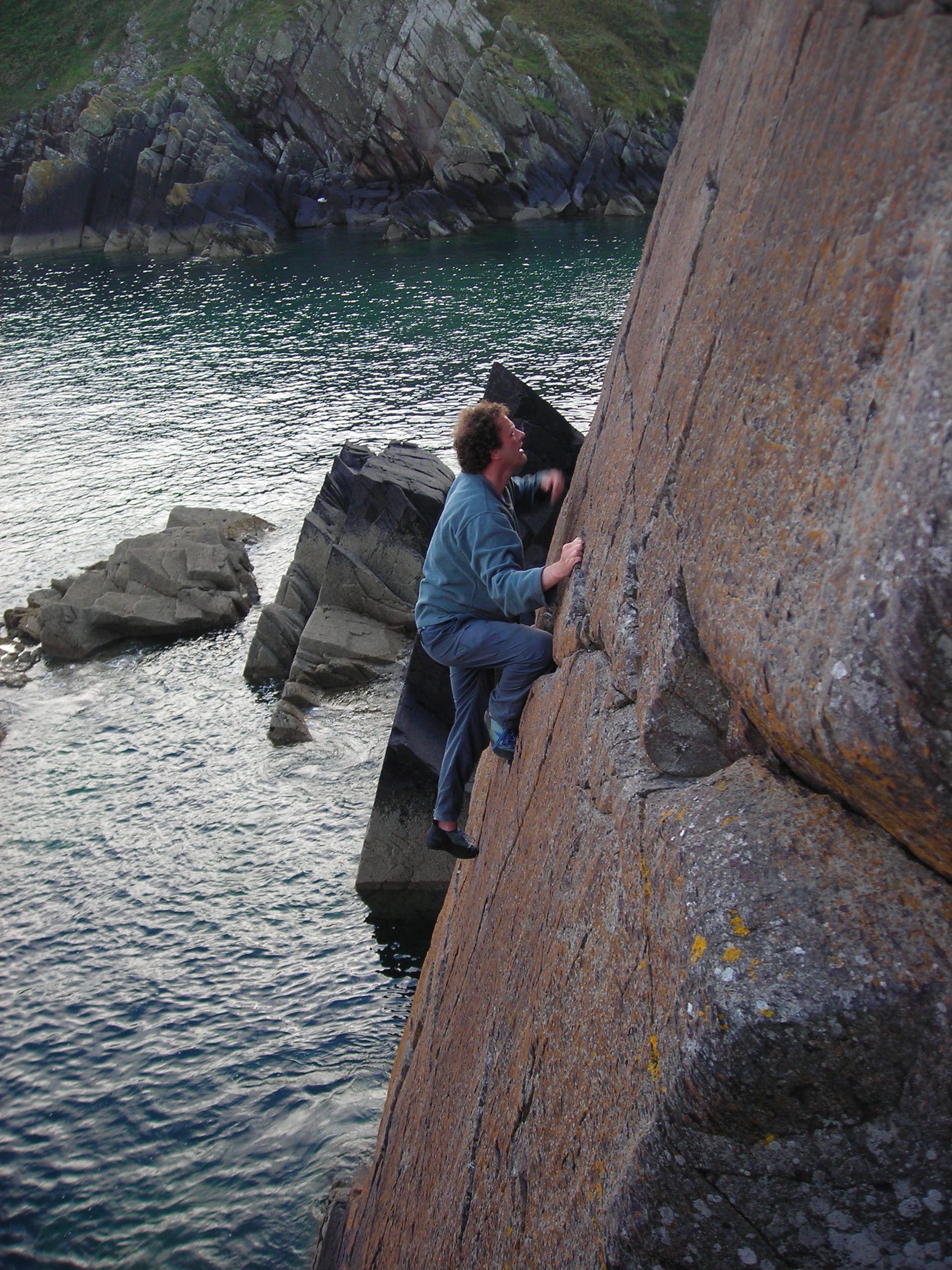
The gentler side of sea-cliff climbing. The author on his umpteenth ascent of Red Wall, Porthclais, near St David’s; this picture gives a much more accurate sense of the character of the route than the cover picture of the Mortlock guide!
Robert Cecil Jones (1932 – 2023)
My father, Robert Cecil Jones, died on Friday 8 September 2023. His 90 year life spanned a childhood and youth in Aberystwyth, 16 years service in the Royal Air Force, a spell as an adult educator in Birmingham and a second career as a priest in the Church in Wales. He is survived by his wife of 67 years, Sheila, and me, his only child, Richard.
Robbie’s mother, Gladys Jones (née Williams), was from Yspyty Ifan, in the Conwy valley; Len Jones was a journeyman butcher from Conwy. Robbie was born in Colwyn Bay in 1932, but the family soon moved to Aberystwyth, where Len carried out his trade for Dewhurst the Butchers until his death in 1971. The family lived without interruption in the same house on Dinas Terrace, where Gladys took in visitors for Bed and Breakfast.
Robbie was an only child, and for much of the war he was brought up by Gladys alone – Len was conscripted in the Royal Armoured Corps. He was a tank crewman who was captured at the Battle of Tobruk, and spent the rest of the war as a prisoner of war, first in Italy, then Germany. Robbie attributed his close bond with his mother (and, less plausibly, his love of ice cream) to this wartime period.
He was educated at Ardwyn Grammar School – there, in 1949, he first met Sheila Howell Lewis, the love of his life. They married in 1956. He did well at school (except at maths, which in those days didn’t seem to matter so much), and was offered a place at Oxford. He couldn’t afford to take that up, but instead studied geography at the University College of Wales Aberystwyth, living at home, alongside the other students Gladys took in as lodgers.
He’d talk about his university years with great affection – he was active in student politics, in amateur drama, in entertaining visiting dignitaries to the university (a rowdy night out with Dylan Thomas being something he recalled with particular pleasure). He was involved in many high spirited pranks at the expense of the town and university authorities. He’d recall these with all the more amusement for the fact that some of his co-conspirators went on to become pillars of the Welsh legal and political establishment.
Robbie always spoke with enormous gratitude for both his parents, who had had very little education themselves, but never hesitated in their support for his studies. After his BA, he trained as a teacher, and then started research for a Masters in historical geography, working with the great Welsh geographer Emrys Bowen, while supporting himself working as a journalist on the Cambrian News. But he concluded that the academic life wasn’t for him.
Faced with the need to do National Service, he chose to apply for a short-service commission in the RAF instead. After officer training in the Isle of Man, he was posted to the V-bomber base, RAF Wittering, near Stamford, moving there with Sheila. At the end of the commission, he and Sheila stayed in Stamford, where Sheila had a teaching job. Robbie got a job teaching in the same school. This didn’t really work out – it didn’t do a lot for his self-confidence that his wife had to intervene to maintain discipline in his classes. But it was in their short stay in Stamford that their only son, Richard arrived.
The solution was to rejoin the RAF, which accepted Robbie for a full 16 year commission. His first posting was back to the Isle of Man, turning from trainee to trainer at the Officer Training Unit at Jurby. This was a happy time for Robbie and Sheila, who made some lifelong friends there.
Robbie’s RAF service continued, with postings to Feltwell and Brampton in East Anglia. A less happy time followed in 1967, when Robbie was posted to Aden, to assist with the UK’s chaotic and violent withdrawal from this outpost of Empire. Aden, in the grip of a bitter insurgency, was too dangerous for families, so he had to leave his behind, to live in Pwllheli close to Sheila’s parents. Better times came with a move from Aden to Sharjah, in what’s now the United Arab Emirates; still without his family, but without Aden’s bloody conflict. There he enjoyed roving across the deserts and mountains of Arabia, training with the RAF’s Mountain and Desert Rescue Team.
Back in the UK, and back with the family, postings followed to Cosford, near Wolverhampton, and finally to Bicester. Then the time came to leave the RAF, and adjust to civilian life. He took up a position in adult education in Birmingham, a rewarding time.
Christianity was always important to Robbie. He’d considered entering the ministry as a young man, but had been discouraged by his mother (though she herself was always a devout churchgoer), and had followed the advice of an important mentor that he should spend some time in a secular career first. While he was in Birmingham, he became a lay reader. Finally he decided that the time was ripe for him to enter the ministry full time, and he was accepted as a trainee priest by the Diocese of St Davids, in the (Anglican) Church in Wales.
After 2 years in theological college in Birmingham, he returned to Aberystwyth as a curate in the beautiful and historic church of Llanbadarn Fawr. His mother Gladys was thrilled to have him back close, and he spoke with huge admiration and respect for the Vicar he served under and learnt so much from, Hywel Jones. With his return to Wales came a refreshing of his Welsh language. Welsh was Robbie’s mother tongue, but as was very common in those times, his education was exclusively in English. Expressing the subtleties of theology in Welsh was a challenge at first, but he soon found his feet for preaching in his native tongue. Whether in Welsh or English, some who knew his quiet-spoken everyday manner could be surprised by the passion of his public speaking – real hwyl.
His first parish was the Ceredigion coastal resort of New Quay/ Cei Newydd. Before long he was offered the opportunity to move to Newport/ Trefdraeth, in Pembrokeshire. This he gladly seized; Sheila was born and spent her early childhood in North Pembrokeshire, so this was a return to the family homeland for her. The position of Rector of Newport wholly suited Robbie, who took very seriously the idea that an Anglican priest should serve the whole of the community whenever there was a need, whether they identified as churchgoers or not. He could relate equally to the Welsh speaking rural communities of the Gwaun Valley, with their deep traditions, as to those who had retired to this charming seaside village. He was proud to be appointed to the traditional position of Mayor of Newport.
After retirement, Robbie and Sheila moved a few miles down the coast to Fishguard. But the arrival of grandchildren persuaded them to relocate once again, to Stoney Middleton, Derbyshire, to be closer to their son Richard, daughter-in-law Dulcie, and grandchildren Rosie and Thomas.
But retirement, for Anglican priests, is a relative concept, and Robbie was soon drawn in to frequently helping out with services in the local churches, supporting the overstretched rural vicar. He continued serving the community in this way well into his 80s, until deteriorating health finally forced him to retire for good.
Climbing stories, climbing fictions
I call myself a rock climber, and sometimes I manage to do some climbing too. This summer I’ve been out a few times with a new climbing partner, Mike. Mike’s a writer – M. John Harrison – whose most famous work is the science fiction trilogy Light, Nova Swing and Empty Space. I’ve written about these brilliant books before. But it’s another novel of his that these climbing trips have brought to mind – his 1989 novel “Climbers”.
“Climbers” is a beautifully written book, formally clever and an utterly perfect evocation of a certain time and place, a certain milieu – the Peak District climbing scene in the late 70’s and early 80’s. This I know, because I was there – at least, as a youth learning to climb myself, I was on the fringes of this scene.
This is how it happened. 1979 was the year I left school. That summer, my friend and climbing companion, Mark, having been expelled from school (the reasons for which are another story), had moved to the Peak District. His parents had divorced, and he went with his mother, first to a mobile home outside Chesterfield, then to the village of Tideswell. I visited him there, staying in his mother’s tiny cottage and hitching to the crags, Mark in a greatcoat, with their Jack Russell sticking its head out of his rucksack, an ancient Karrimor Pinnacle that he’d stolen from school. Continue reading “Climbing stories, climbing fictions”
Land of my Fathers (and they can keep it)
When someone asks me “where do you come from”, my reply is generally “I’m Welsh. A Welsh Jones. Descended from a long line of Joneses” (and Lewises and Williamses and Howells and so on). But then I have to qualify this, not least because I don’t sound Welsh: I sound like someone who’s spent 15 years in Cambridge (with maybe a bit of east midlands/Yorkshire influence). I was born in England (Stamford, Lincolnshire); my father had left Wales to join the Air Force, so my early childhood was spent trailing around a series of RAF bases in the Midlands and Eastern England. It was only after I finally left home that my parents moved back to Wales. The only time I properly lived in Wales myself was for a year in 1967, an experience that was so alienating and unhappy that, even though it was a short time, and a long time ago, it colours my emotional response to that part of North Wales, the Lleyn Peninsular.
The circumstances were this – after a couple of postings in East Anglia, my father was sent abroad, to help with what turned out to be the shambolic and violent end of one corner of the British Empire, in Aden, now in the Yemen. Aden was then a Crown Colony, a strategic port and military base for the British, usefully placed on the way to India and the Far East. Britain’s retreat from Empire reduced the port city’s value, but through the mid-1960’s a worsening insurgency had destabilised the British’s attempt to install a friendly government before they left. By 1967 parts of the city were alternately a no-go zone for the British troops, then being reoccupied with some brutality. Finally (and I think uniquely in the end of Empire) there was no orderly hand-over when the British left, no ceremonial lowering of the flag, no hand-shakes between the Governor-General and the incoming President, just a scramble by the British forces to get out with as much of their kit as they could carry. My father’s part in the retreat, having organised the repatriation of the remaining families, was to tip Radio Aden’s record collection off the Steamer Point quay into the harbour, to make sure the Communist hordes of FLOSY and NLF didn’t benefit from the latest Jazz and Pop sounds (for some reason he saved one Thelonius Monk album, which I still possess).
Aden was clearly not a place for dependents, so my mother and I were packed off to the North Wales seaside town of Pwllheli, where my mother’s parents lived. There my mother tried to avoid reading the newspapers, with their reports from Aden of random shootings and grenade attacks, while the six-year-old me went off friendless to a new school. I remember the terrible food and the boys’ toilet, outside, in the corner of the playground, a slate urinal brilliant green with moss and with an overwhelming ammoniacal smell of decaying boys’ urine. The school was old-fashioned in teaching methods and discipline – I vividly remember an assembly with a purple faced teacher standing on a stage, roaring with anger and threateningly waving his stick above his head. I never found out what atrocity it was that some child had committed, as the diatribe was conducted, like all the other business of the school, entirely in Welsh, a language I didn’t know then (and still don’t).

West End Parade, Pwllheli, N. Wales. A flat in one of these houses was my unhappy home for a year.
My mother must have been bored, worried, lonely. At least she had a car, a sweet little Mini, in which she frequently drove me to Caernarvon Castle, with which I became fascinated. She would take her own father on trips a few miles up the coast, to see his friend, the priest and poet R.S. Thomas. I don’t exactly know what had drawn Thomas and my grandfather together, whether that was religion, or poetry, or simply a shared gloomy disposition. My grandfather died before I got to know him properly; I know he was a cultured man, though he had dropped out of theological college to become a Conservative Party activist.
Something I don’t remember myself, but which my mother tells me, is that for the first few months I refused to talk about my father at all, or even acknowledge his existence. Continue reading “Land of my Fathers (and they can keep it)”
I chose to graduate
I’m sure there are some people who, very early on in their lives, work out what they want to do and then set out single-mindedly to achieve their aims. For the rest of us, choices are made and paths are set without us really being conscious of those junctions, so we look back and wonder how was it that our lives unfolded in this way and not in another. And yet, looking back, we sometimes can see moments, or short periods, that were decisive in setting us down one path and cutting off other possibilities. For me, the summer of 1982 was the time that determined that I was going to end up being a scientist, and to some extent what sort of scientist I would end up being, though I don’t suppose at any moment at the time I had any idea that this was the case.

The East Face of Mont Blanc du Tacul, a 4,248 m peak in the French Alps
It began on the bus to Chamonix, in the French Alps, in the summer vacation after my second year at University. Continue reading “I chose to graduate”